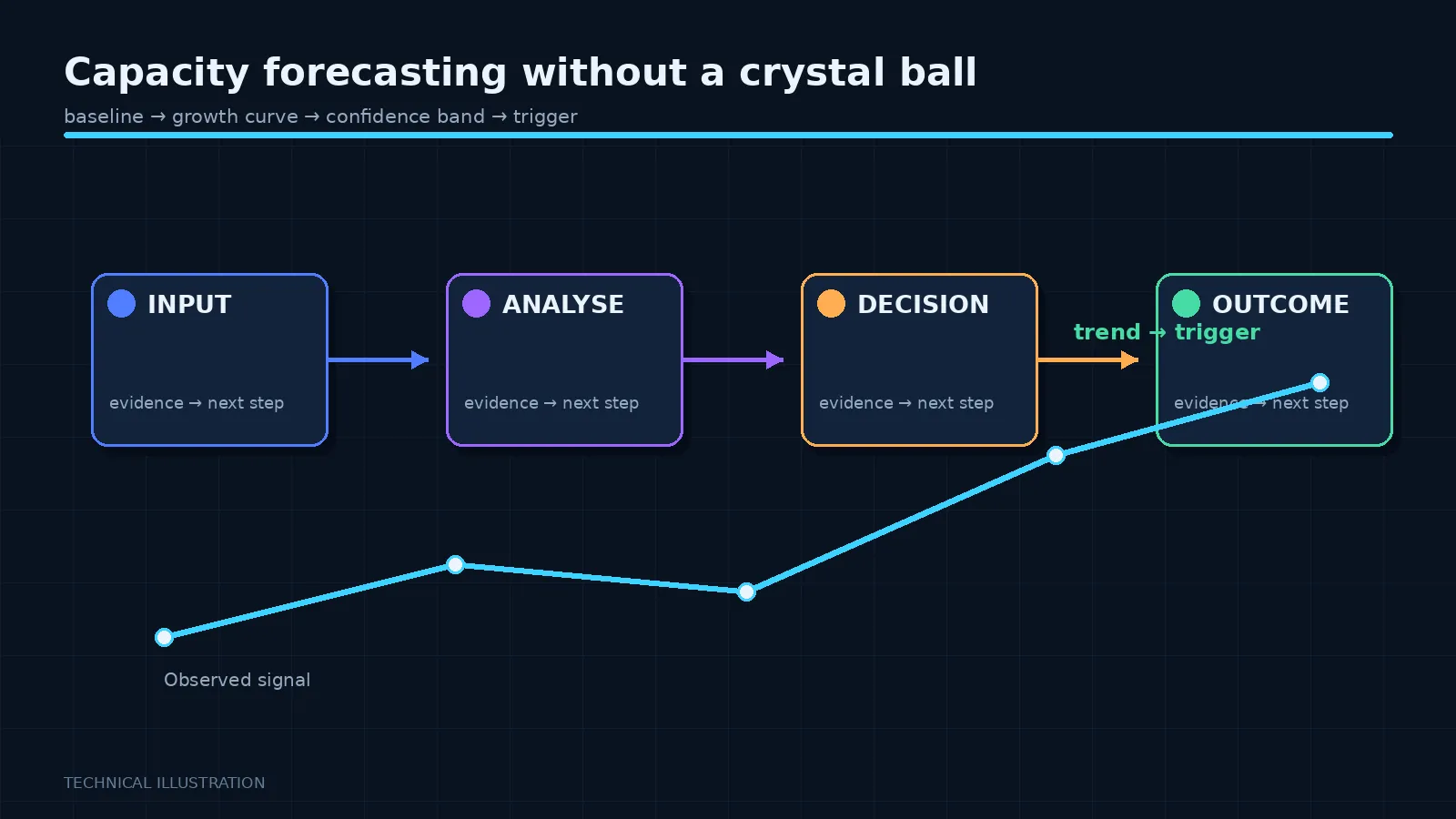
 Capacity planning in most organisations means noticing that storage is filling up, extrapolating from the last year, and adding a margin. That method is better than nothing and it fails in specific, predictable ways.
Why the straight line misleads
Growth is rarely smooth. It arrives in steps when a project lands, a new system is onboarded, or a retention policy changes. A trend line through a period containing one step predicts continued steps that will not happen; a line through a quiet period predicts a calm that will not last.
The past includes deletions you will not repeat. A big clean-up last spring flattens the curve and hides the underlying rate.
Different data grows differently. Blending everything into one number averages a database growing steadily with an archive growing in jumps, and describes neither.
Three improvements worth making
Separate by workload. Forecast each major category on its own: virtualization, databases, file shares, backup, archive. Five lines instead of one, and each is more predictable than the aggregate. The differences are informative on their own — frequently one category is responsible for most of the growth and nobody had noticed.
Ask the project pipeline. Most step changes are known in advance by somebody. A quarterly conversation with whoever runs the project portfolio converts surprises into planned events. This is the highest-value thing on the list and it requires no tooling at all.
Forecast a range, not a point. Best case, expected, worst case, with the assumption behind each stated. Then decide what you procure against. Usually you procure against expected and plan the trigger for worst.
The number that matters more than the forecast
Lead time. How long between deciding you need capacity and having it usable, including procurement, delivery, installation and migration.
If that is four months, your forecast horizon must exceed four months and your trigger point must be set accordingly. A forecast that tells you you will be full in ten weeks, when lead time is sixteen, is not a plan, it is a warning.
Measure your actual lead time from the last three purchases rather than assuming. It is usually longer than people think, and in periods of supply constraint it can double without anyone updating the assumption.
Triggers, not reviews
Set a threshold that initiates procurement automatically, derived from lead time and growth rate rather than from a round number.
If you grow 2% a month and lead time is four months, you need roughly 8% free when you start, plus a safety margin, plus whatever headroom the platform itself requires to operate well. Many systems degrade before they are full, so the effective ceiling is below 100%, and the threshold should be computed from the effective ceiling.
This converts capacity management from a monthly meeting into a rule.
The thing that changes the picture entirely
Before buying, ask what could be deleted or moved. Old snapshots, orphaned volumes, data past its retention policy, cold data sitting on the expensive tier.
In most estates this is between ten and thirty percent, and it is available immediately at no capital cost. A capacity plan that does not include a reclamation step is asking for money to store data nobody wants.
Run the reclamation first, then forecast from the cleaned baseline. The forecast is more honest and the purchase is smaller.