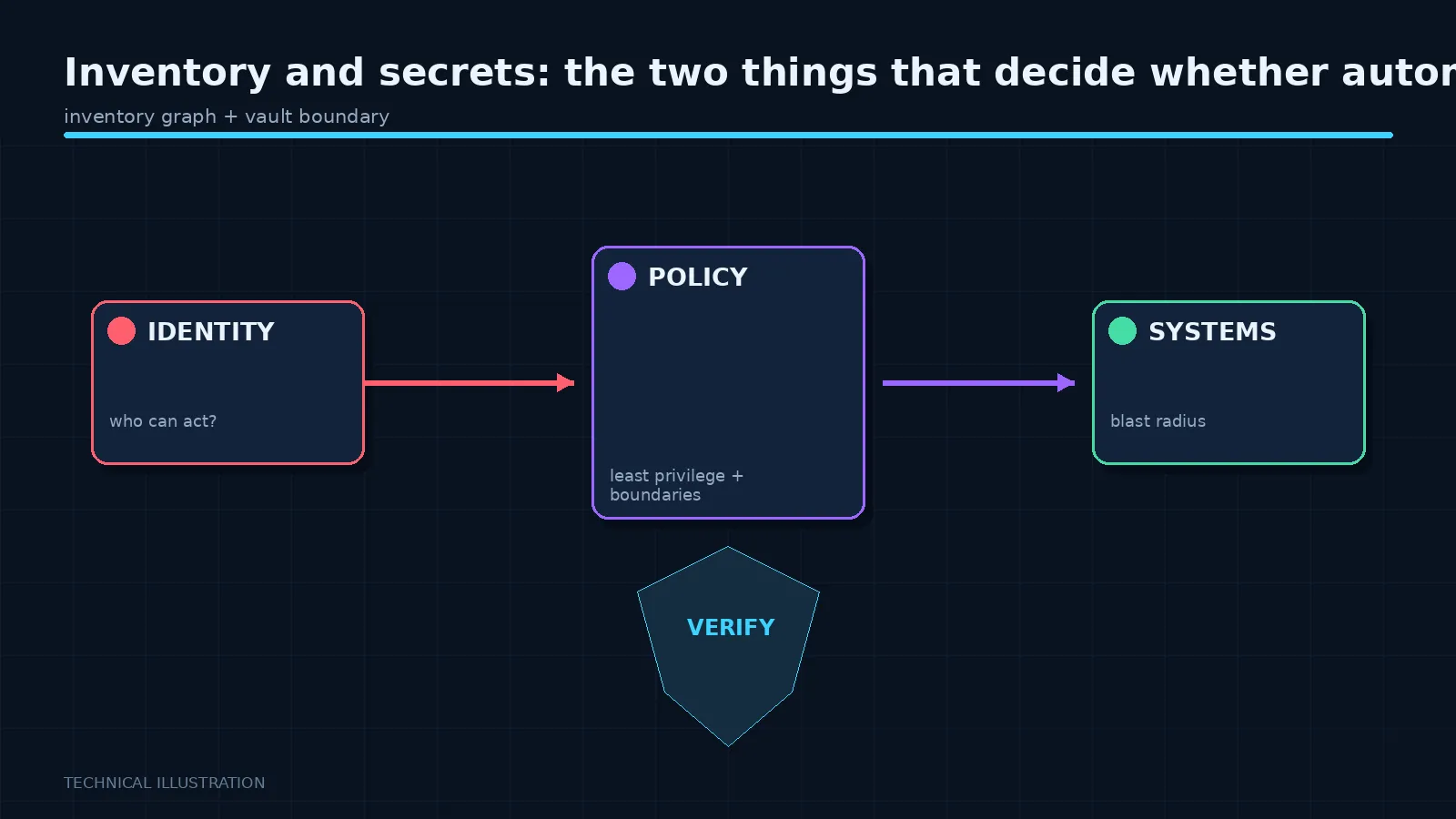
 Playbooks are the visible part and the easy part. The two things that determine whether an automation practice survives contact with a real estate are where the list of machines comes from and where the credentials come from.
Inventory: stop maintaining a list
A static inventory file is fine to start and becomes wrong immediately. Machines get built and decommissioned, and the file is updated by whoever remembers.
The fix is to generate inventory from a system that already knows: your virtualization platform, your cloud provider, your CMDB if it is trustworthy, your IPAM if it is. Dynamic inventory plugins exist for most of these and the setup is an afternoon.
Once inventory comes from the source of truth, a new machine is automatically in scope and a decommissioned one is automatically out. That property is what lets automation coverage stay at a hundred percent instead of decaying.
Grouping is the design work
The grouping matters more than the source. Groups are how variables get applied, so the group structure is effectively your configuration model.
Useful axes: environment, function, operating system, location, and criticality. A host belongs to several groups and inherits variables from all of them, with precedence rules you should read once and then write down for your team.
The common mistake is grouping by team or by project, which changes constantly. Group by properties of the machine, and let tags or variables carry the ownership information.
Secrets: the decision that has to be made early
Automation needs credentials: to log in, to authenticate to APIs, to configure services with passwords. Where those live is the question that stalls many projects.
Vault files are the built-in answer: encrypted files committed to the repository, decrypted at runtime with a key. Simple, no extra infrastructure, and the key becomes a thing you must distribute and rotate. Workable for small teams and awkward beyond that, because everyone who runs playbooks needs the key.
An external secret store is the better answer at any scale: a dedicated vault product, a cloud secret manager, or your existing privileged access system. Playbooks look up secrets at runtime, using an identity of their own rather than a shared key. Rotation happens in one place, and access is audited.
The automation platform’s own credential store, if you are running a controller rather than executing from laptops, which you should be past a certain point.
What matters is choosing one early, because retrofitting secret management onto a hundred playbooks that embed credentials is a miserable and risky exercise.
The thing nobody mentions
The credential the automation itself uses is extremely powerful. An account that can log into every server and change configuration is, functionally, domain administrator by another name.
Treat it as tier-zero. Separate identity where possible, strong authentication, no interactive use, logged. If your automation account is a service account with a static password documented in a wiki, you have built a very efficient lateral movement tool.
The practical sequence
Get dynamic inventory working before you write many playbooks. Choose the secret store before you write any playbook that needs a credential. Both are an afternoon each at the start and a month each to retrofit.
Everything else about automation can be improved incrementally. These two are foundations, and foundations are cheap to lay and expensive to replace.